
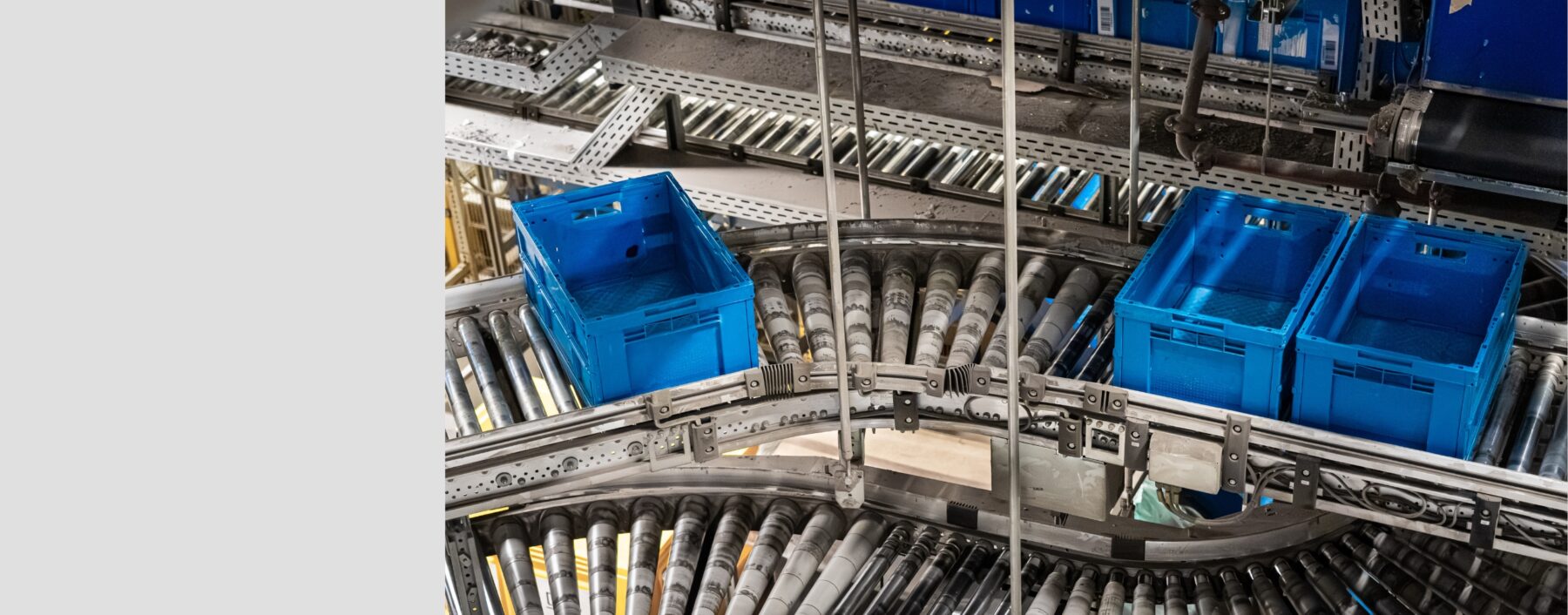
Special folding and collapsible boxes as well as trays from WALTHER Faltbox Group are in use in fully and semi-automated warehouses.
Automated storage technology: Load carriers for warehouses
Automated storage technology
Specific requirements
Containers for automated storage systems and logistics processes
Digitalization and Industry 4.0 have fundamentally transformed logistics. Fully automated warehouses are now established worldwide and enable efficient and precise control of material flows.
In automated storage and conveyor systems, containers play a central role. They ensure the secure provision, structured transport and reliable storage of a wide range of goods and components within complex system environments.
Especially in automated processes, the use of robots, stacking systems and extensive conveyor lines requires load carriers to be 100% reliable. Even minor deviations can affect process reliability and lead to disruptions in material flow.
Load carriers as a controlling element
Today, load carriers are a dynamic part of the computer-controlled ecosystem within the warehouse. From the moment goods are received, they are transferred onto or into the appropriate load carriers and subsequently stored.
Once the goods are placed on the load carrier, the system always knows their location as well as the contained items. Additional information can be stored and retrieved using identifiers such as barcodes.
Via conveyor belts, storage and retrieval machines or roller conveyors, load carriers are transported to their designated storage location, which is automatically calculated and assigned by the system. Various factors are taken into account, such as the frequency with which an item is accessed.
Requirements for containers in automated storage and conveyor systems
Containers in automated systems are an integral part of technical processes. They must integrate seamlessly into existing storage, conveyor and handling systems and ensure reliable performance within complex operations.
Requirements arise from the interaction between conveyor technology, automated storage systems and the goods being handled. Accordingly, the demands on design, material and functionality are high.
- Dimensional accuracy: precise dimensions for smooth handling in automated systems
- Structural stability: reliable performance under continuous load and high circulation rates
- System compatibility: suitability for conveyor systems, shuttle systems, grippers and automated storage technology
- Process reliability: stable material flow without jamming, slipping or disruptions
- Stackability: efficient use of storage capacity in manual and automated environments
- Load capacity: safe handling of various goods under repeated use
- Cost efficiency: reliable operation and reduction of process costs through durable reusable containers
Which containers are used in automated storage and conveyor systems?
Depending on the type of system, conveyor route and handling process, different container solutions are used in automated storage technology. Selecting the right system has a direct impact on process stability, system availability and the efficiency of the overall material flow.
- Small load carriers (KLT): standardized containers for automated conveying, storage and picking processes
- System containers: solutions tailored to specific systems and technical interfaces
- Stacking containers: for structured storage processes with high space efficiency
- Special containers: individually adapted designs for specific goods, processes or system requirements
The selection of the appropriate container depends, among other factors, on the goods being handled, the level of automation and the technical requirements of the respective system.
Reliability for complex processes
In addition to fully automated warehouses, where goods are handled by robots and automated systems, partially automated processes have also become established. In these cases, containers are transported via conveyor systems to picking stations, where the required items are removed.
The containers are then reintegrated into the material flow and transported to a new storage location. A smooth execution of these processes is essential for the overall system performance.
The requirements for load carriers on automated conveyor systems are therefore diverse. High reliability is the foundation for stable and efficient operations.
When are containers particularly suitable for automated systems?
Containers for automated storage and conveyor systems are particularly suitable when processes require high repeatability, consistent material flows and reliable technical handling.
- High process density: reliable performance in continuous movement and handling operations
- Automated conveyor lines: secure transfer between different technical systems
- Standardized processes: consistent conditions for repeatable operations
- Technically demanding systems: precise alignment with grippers, conveyor and storage technology
- Efficient use of space: structured storage and optimal utilization of available capacity
Due to their coordinated properties, suitable containers help to ensure stable, efficient and cost-effective automated processes.
Customer examples
Reference projects
The following customer examples show how reusable containers are used in practice and which requirements they meet in real logistics processes.

Individual advice
Do you have any questions regarding our reusable load carriers?
Then please get in touch. Our experts will be happy to advise you individually and help you find the solution you need.

Thomas Schleisick
Head of Business Development
Our online shop
You can find standard size folding boxes in our online shop
It does not always have to be a customised product. In our online shop, you will surely find the right solution for your needs from our standard range.